
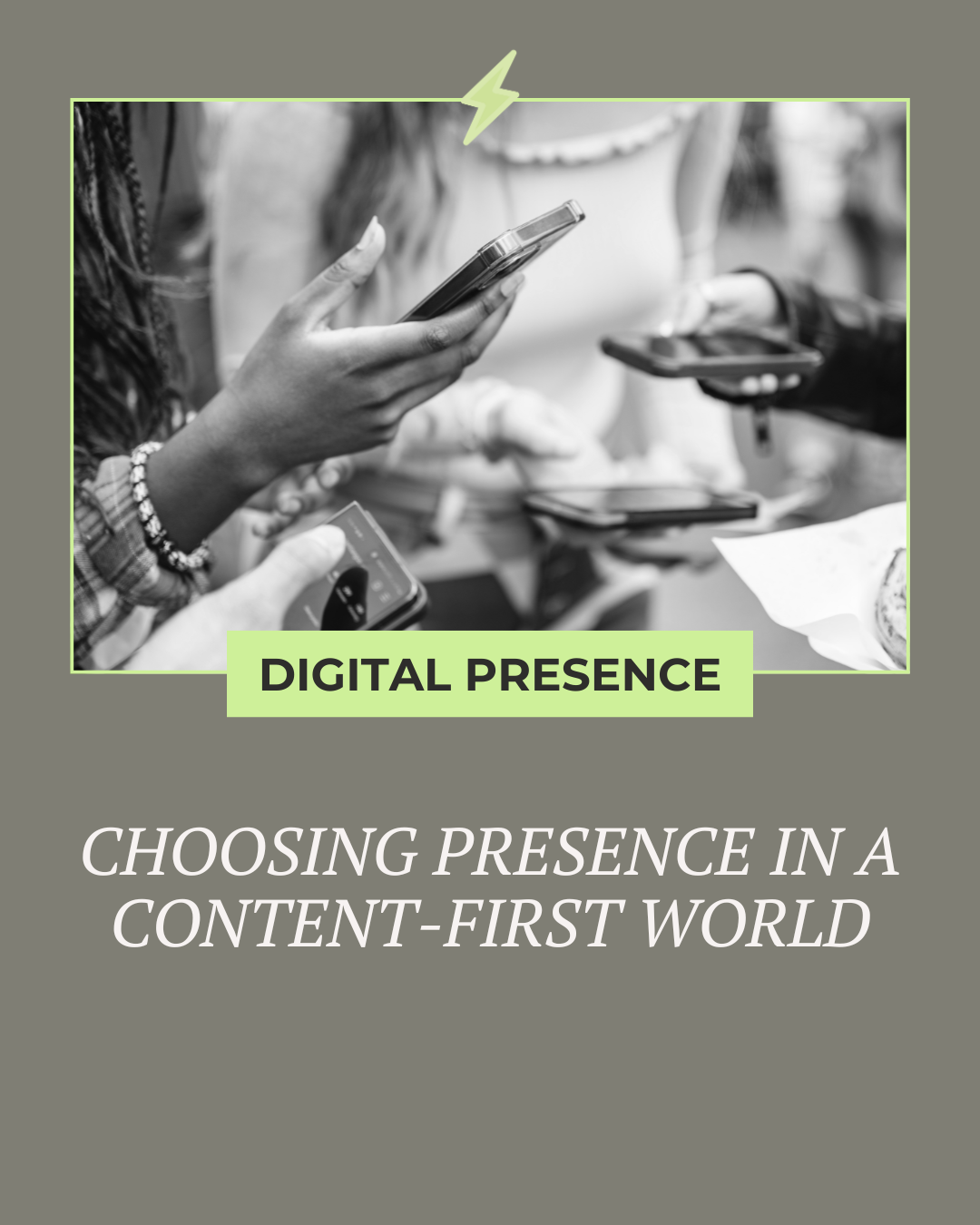
Choosing Presence in a Content-First World
I’ve decided 2026 is the year I put my foot down.
Or more accurately, the year I put my phone down.
Not in a dramatic “digital detox” announcement way. Not a disappearing act. Just a choice. A shift. A reorientation. I want my actual, in-the-room life to matter more than the version of it that ends up online.
This decision isn’t just personal. It’s professional. And honestly, philosophical.
Personally: Real Conversations over Passive Touchpoints.
I’m done confusing proximity with presence.
Watching someone’s Instagram story is not keeping in touch. Sending a “thinking of you” text and calling it a connection is not a connection. If I want someone in my life, I want them across the table from me, coffee in hand, unfiltered conversation, no agenda.
My word for 2026 isn’t growth, expansion, or whatever LinkedIn is pushing this quarter.
It’s presence.
Professionally: Create FOMO through Feeling, not Posting.
I’m an Experience Designer, and my career shoved me face-first into this realization.
I started at Forbes, where the Under 30 Summit was the place to be. Thousands of success-obsessed young professionals sprinting, scheming, pitching, learning, connecting, whatever they needed to do to feel like they were building something. The energy was real because the people were real. You were breathing the same air as founders, innovators, and big-thinkers who made you want to level up.
Then the pandemic arrived and flipped the table. Overnight, life went from IRL to URL. Entire communities, teams, industries, friend groups, were forced into digital connection. And we did what humans do: we adapted. I produced virtual events where people never left their couch but somehow felt like they were part of something. And we needed that at the time.
Then came the rebound, the “get me out of my house before I lose my mind” renaissance. The industry exploded. People booked trips just to feel something. Pop-ups were everywhere. The restaurants were full again. And then… we swung too far. Again.
The pendulum landed squarely in performance mode. Suddenly every real-life moment needed to be optimized for online visibility. I produced pop-ups across the country with Bucket Listers where hours (literal hours) were spent discussing the perfect camera angle, the perfect lighting, the perfect “Instagrammable moment.” The conversation wasn’t about how something felt, it was about whether it would go viral.
And somewhere in that cycle, I felt the soul of in-person connection slipping.
So here’s my unedited truth: I don’t want to design “Instagrammable moments” anymore. I want to design moments that make you forget to take out your phone. Moments that spread because someone says, “You have to go. I can’t even explain it, you just have to be there.” That’s the kind of FOMO we’ve lost. And the kind I’m bringing back.
Industry-wide: Design for People, not Algorithms.
We’ve spent a decade engineering experiences around algorithms. Photo ops. Shareability. Growth hacks. Everything we built was optimized for reach, not resonance.
But the tide is shifting. People are tired. Brands feel flat. Experiences feel predictable. Real human connection is becoming the differentiator again.
And yes, I get the tension. We live in a content-first economy. Posting about work is part of the job, it gets you noticed, it creates opportunity. I’m doing it too. But the recap video should never matter more than the experience itself. The algorithm shouldn’t decide what is meaningful.
The North Star: Presence over Performance.
I’m not anti-tech. I’m not disappearing from the internet. But I’m shifting the mindset:
Less “How will this look online?”More “How will this feel when you’re actually standing here?”
More intention. More humanity. More experiences that hit in the room and stay with you long after. If I can design experiences that help even a handful of people feel that shift? That’s the work I want to be known for.
And that’s the direction I’m choosing personally, professionally, and for the industry I care about.
The Reality of Digital Presence.
Here’s the contradiction I’m holding honestly: my online presence has opened doors I didn’t know existed. When someone reaches out to connect, I look at their socials immediately. Digital presence is a double-edged sword. It has to represent you without overcompensating for you.
I launched a business Instagram so my friends don’t have to see my evolving opinions on dinner napkin colors. But it’s also a personal challenge. I don’t want my digital presence to speak differently than my IRL one. I want people to know I’m doing the work—without turning my life into a performance.
So in 2026, I’m committing to this:
I want to live a life that’s worth posting about, without feeling the need to post it. I want my online presence to be authentic, not programmed. I want to use my phone to capture memories, not to numb, compare, or scroll myself into someone else’s life.
Presence first.
The rest can follow.
Written by Kayla Jennings-Rivera (Studio KJR)
Kayla Jennings-Rivera is an Experience Designer based in Hollywood who builds moments people actually remember. With a foundation in storytelling from NYU Tisch School of the Arts and Rutgers University, she blends creative strategy with real-world execution to design experiences that feel intentional, immersive, and human.
Her background spans media, culture, and live experiences, with past roles at NBCUniversal, Forbes, Bucket Listers, Hampton, and Coffee N Clothes where she’s helped shape everything from large-scale conferences to brand-driven moments to specialized retreats.